
Buying Guides
kVA to kW: What the Rating on Your UPS, Inverter and Generator Really Means
· 9 min read · Energy Links Ghana
One kVA is not one kilowatt, and that single fact is the most common reason a customer ends up with equipment too small for the job. A 1 kVA UPS will not carry a 1,000 watt load. A 100 kVA generator is not a 100 kW generator. The rating on the box and the number your load actually needs are two different quantities, measured on two different scales, and the bridge between them is the power factor.
The short version. kVA is apparent power — the product of volts and amps, which is what the equipment's electronics, windings, cables and breakers must physically carry. kW is real power — the part that does work, turns a motor, lights a lamp, heats an element. Multiply kVA by the power factor and you get kW. So kVA multiplied by 0.8 equals kW at a power factor of 0.8, and at a power factor of 1.0 the two numbers are the same.
Everything else in this article is the detail that stops you from getting the arithmetic right but the decision wrong.
What does kVA mean?
kVA stands for kilovolt-ampere. A volt-ampere is a volt multiplied by an amp. A kilovolt-ampere is a thousand of them.
That sounds like it should be a watt, and in a direct-current circuit it would be. In an alternating-current circuit it is not, because voltage and current do not always rise and fall together. Some loads — motors, transformers, fluorescent ballasts, the input stage of older power supplies — draw current that lags behind the voltage waveform. The current is genuinely flowing and the cable genuinely has to carry it, but part of it is not doing any work. It is being pushed into a magnetic field and pulled back out again, fifty times a second.
So an AC circuit has three quantities, not one.
- Apparent power, in kVA, is volts times amps. It is what the hardware has to survive.
- Real power, in kW, is the part that does work. It is what your load list adds up to and what the fuel bill or the battery drain responds to.
- Reactive power is the remainder, shuttling back and forth without doing work.
The ratio of real power to apparent power is the power factor. A purely resistive load — a kettle, a filament bulb, an immersion heater — has a power factor of 1.0, so kVA and kW are identical. A motor under light load might sit at 0.6, and a power-factor-corrected switch-mode supply at 0.95 or better.
How to convert kVA to kW
The formula is short.
kW = kVA x power factor
kVA = kW / power factor
So:
- 1 kVA at 0.8 power factor is 800 W
- 3 kVA at 0.8 is 2.4 kW
- 10 kVA at 0.9 is 9 kW
- 150 kVA at 0.8 is 120 kW
And in the other direction, a load list that adds up to 2,000 W needs 2.5 kVA at a power factor of 0.8, not 2 kVA.
The question that matters is therefore not how to do the multiplication. It is which power factor applies, and that depends on what kind of equipment you are looking at.
Why UPS and generator ratings use different power factors
This is the part almost nobody is told at the point of sale, and it is where two pieces of equipment carrying the same kVA number turn out to have different usable capacities.
Generator sets. Cummins, writing about generator set ratings, states that the ISO 8528-1 standard bases generator set ratings at 0.8 lagging power factor "unless otherwise stated" by the manufacturer. Its explanation of why is the useful part: "Three-phase loads tend to have lower steady state power factors, approaching 0.8, therefore, three-phase generator power ratings are taken at a 0.8 power factor. It is more practical to rate single-phase generator sets at unity (1.0) power factor since most single-phase loads operate close to unity power factor."
Read that twice, because it has a direct consequence in Ghana. A three-phase set is conventionally rated at 0.8, so its kW figure is 80% of its kVA figure. A single-phase set may well be rated at unity, in which case the kVA and kW figures are the same number. Two generators both marked 10 kVA can therefore offer 8 kW and 10 kW respectively, entirely legitimately, because they are rated on different bases. If you are comparing sets, compare the kW figures on the data sheets, and if a data sheet gives only kVA, ask what power factor it was taken at.
UPS systems. Schneider Electric, explaining what a unity output power factor buys you, says that "the more traditional double conversion units have output ratings of kW=0.8kVA", while some of its three-phase products and newer single-phase models have "an output rating of kW=kVA or Unity Power Factor." It also notes the commercial reason this matters: "Traditionally, a UPS with a lower power factor needs to be oversized to support today's power factor corrected loads."
That is the whole problem in one sentence. Modern IT and electronic loads have high power factors, often above 0.9. A UPS rated at 0.8 cannot reach its own kVA number when feeding them, because it hits its kW ceiling first. You end up buying a bigger kVA figure to get the watts you actually needed.
Stabilizers and AVRs are a third case, and here the logic flips. A voltage stabilizer is a voltage-correcting device in series with your load. It is rated in kVA because what it has to carry is current, and its rating is essentially independent of your load's power factor. For a stabilizer, the kVA figure is the one to size against, and you need the VA of your load rather than its watts. For more on where a stabilizer sits in the chain, see surge protector, stabilizer or UPS.
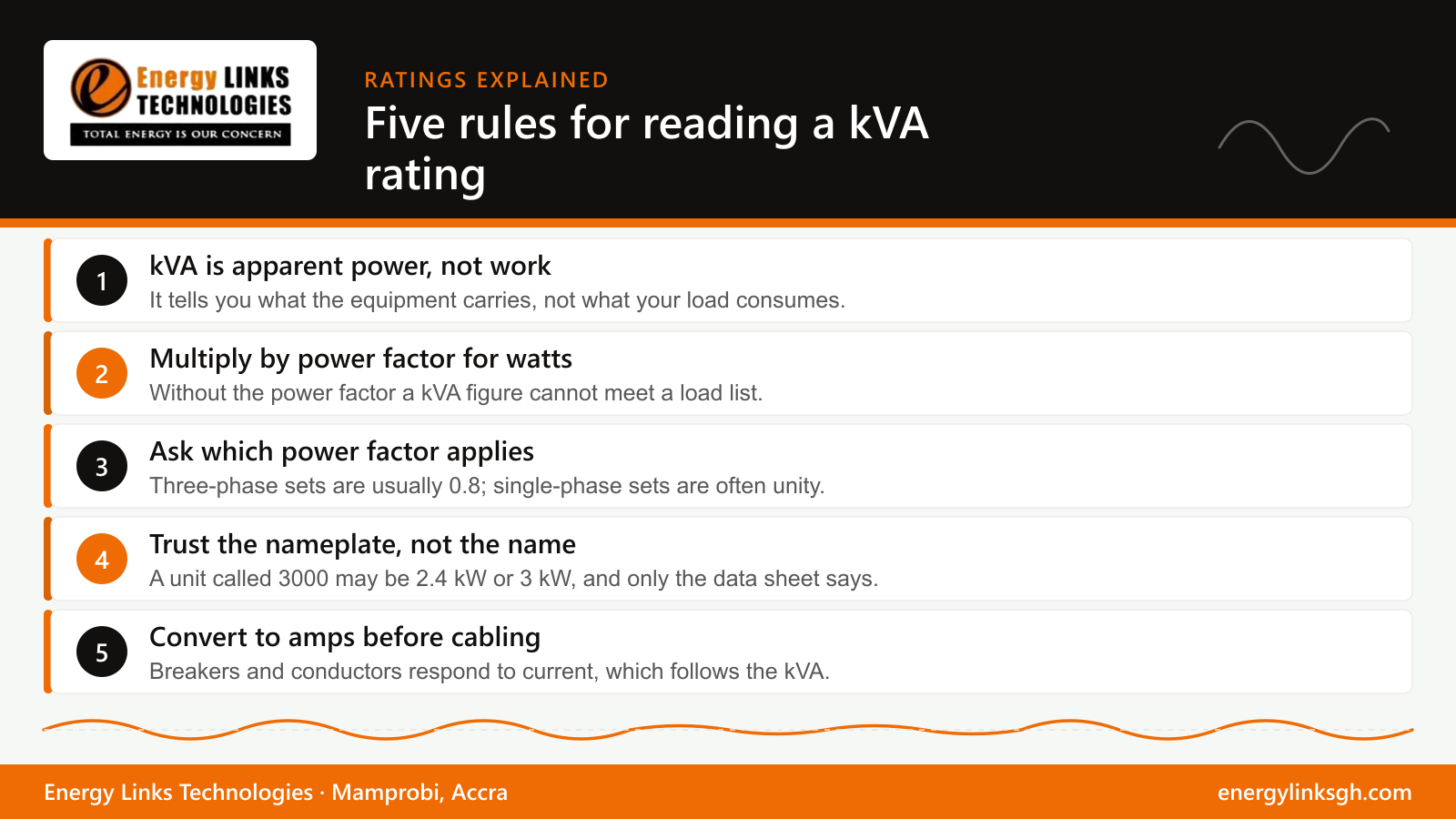
Five rules for reading a kVA rating
- kVA is apparent power, not work. It tells you what the equipment can carry, not what your load can consume.
- Multiply by the power factor to get usable watts. Without the power factor, a kVA figure cannot be compared with a load list.
- Ask which power factor the rating assumes. Three-phase generator sets are conventionally 0.8, single-phase sets are often unity, and UPS systems may be either.
- Trust the nameplate, not the model name. A unit called 3000 may be 3 kVA and 2.4 kW, or 3 kVA and 3 kW. The data sheet settles it.
- Convert to amps before you size cable and protection. Breakers and conductors respond to current, and current follows the kVA figure, not the kW figure.
From kVA to amps, which is what your cables care about
This is the second half of the same question, and the one that keeps installers honest. Current is what heats a cable and trips a breaker, and current comes from apparent power.
For a single-phase supply, amps equal VA divided by volts. For a three-phase supply, amps equal VA divided by the product of the phase-to-phase voltage and the square root of three, which is about 1.732.
The voltages to use in Ghana come from the same convention the whole installation is built on. IEC 60038, the IEC standard voltages publication, added the values 230 V and 230/400 V to its Table 1 in the 2009 seventh edition, and that is the 230V phase-to-neutral and roughly 400V phase-to-phase pairing a Ghanaian building runs on. If you are unsure which of the two you have, single phase or three phase explains how to check.
Worked through:
- A 3 kVA single-phase load at 230V draws about 13 A
- A 10 kVA single-phase load at 230V draws about 43 A
- A 100 kVA three-phase load at 400V draws about 144 A
- A 150 kVA three-phase load at 400V draws about 217 A
Now the Ghanaian wrinkle, and it is a real one. Those figures assume nominal voltage. The University of Pennsylvania's Kleinman Center, reporting on voltage quality in Accra, measured an average of 219V against a 230V nominal between March 2019 and November 2020, with voltage more than 20% below nominal during the 6pm to 10pm peak. A load that draws constant power draws more current as the voltage falls. Size on nominal voltage and you have no margin for the hours when the supply sags, which are precisely the hours your backup equipment is working hardest. This is one of the reasons we size with headroom rather than to the exact figure.
Common mistakes we see
Treating the kVA number as watts. The single most frequent one. A customer with a 2,500 W load list buys a 2.5 kVA UPS and cannot understand the overload alarm. At 0.8 that unit is a 2 kW unit. If your UPS is alarming, why a UPS shows overload works through the diagnosis.
Comparing a single-phase generator with a three-phase one on kVA alone. Different rating bases, as above. Compare kW.
Forgetting that startup is a different number again. A motor or compressor draws several times its running current for a moment at start. Neither the kVA nor the kW figure on the nameplate describes that surge. What size generator do I need and what size inverter do I need both handle the surge allowance properly.
Assuming the conversion is exact. Power factor is a property of your load, and your load changes through the day. The 0.8 and 1.0 figures are rating conventions, not measurements of your building.
Frequently asked questions
How many kW is 1 kVA?
It depends entirely on the power factor. At 0.8 it is 800 W. At 0.9 it is 900 W. At unity it is 1,000 W. There is no universal answer, which is why the rating convention matters more than the arithmetic.
How many kVA is 1 kW?
At 0.8 power factor, 1.25 kVA. Divide kW by the power factor.
Why is my UPS rated in kVA and not kW?
Because the components inside it — the inverter bridge, the transformer if it has one, the output wiring — are limited by the current they carry, and current follows apparent power. Many manufacturers now publish both figures, and reputable data sheets always do.
Does a higher power factor mean better equipment?
For a UPS output rating, a unity power factor rating means more of the kVA figure is available as watts, which is useful. For your load, a high power factor means you draw less current for the same work. Neither is a quality score on its own.
Can I just use 0.8 for everything?
It is a safe default for three-phase generator sets and for traditional double-conversion UPS systems, because that is the convention those products are rated on. For a stabilizer, size on VA instead. For anything you are about to buy, read the data sheet.
Does the kVA rating change at high temperature?
The rating does not, but the usable output can. Equipment derates in heat, and a unit in an unventilated room in Accra will not deliver what it does on a test bench. See how long a UPS battery lasts for how temperature behaves in practice.
Getting it right the first time
The conversion takes ten seconds. Working out which power factor applies, what your real load list is, what it does at startup and what the supply at your address is doing at 7pm takes a site visit. We stock EAST, Inform and Siel UPS systems, Ortea stabilizers and Power Star equipment, and our engineers do the survey, the installation and the servicing.
Bring us your load list or your existing nameplates and we will tell you what the ratings mean for your building. Talk to us or browse the shop. Costs depend on the configuration, so we quote after the survey rather than before it.
Need help choosing the right equipment?
Our engineers will size it against your actual load, not a guess.
Talk to us