
Inverters & Solar
Which Battery Is Best for Your Inverter? Tubular, AGM, Gel and Lithium Compared
· 12 min read · Energy Links Ghana
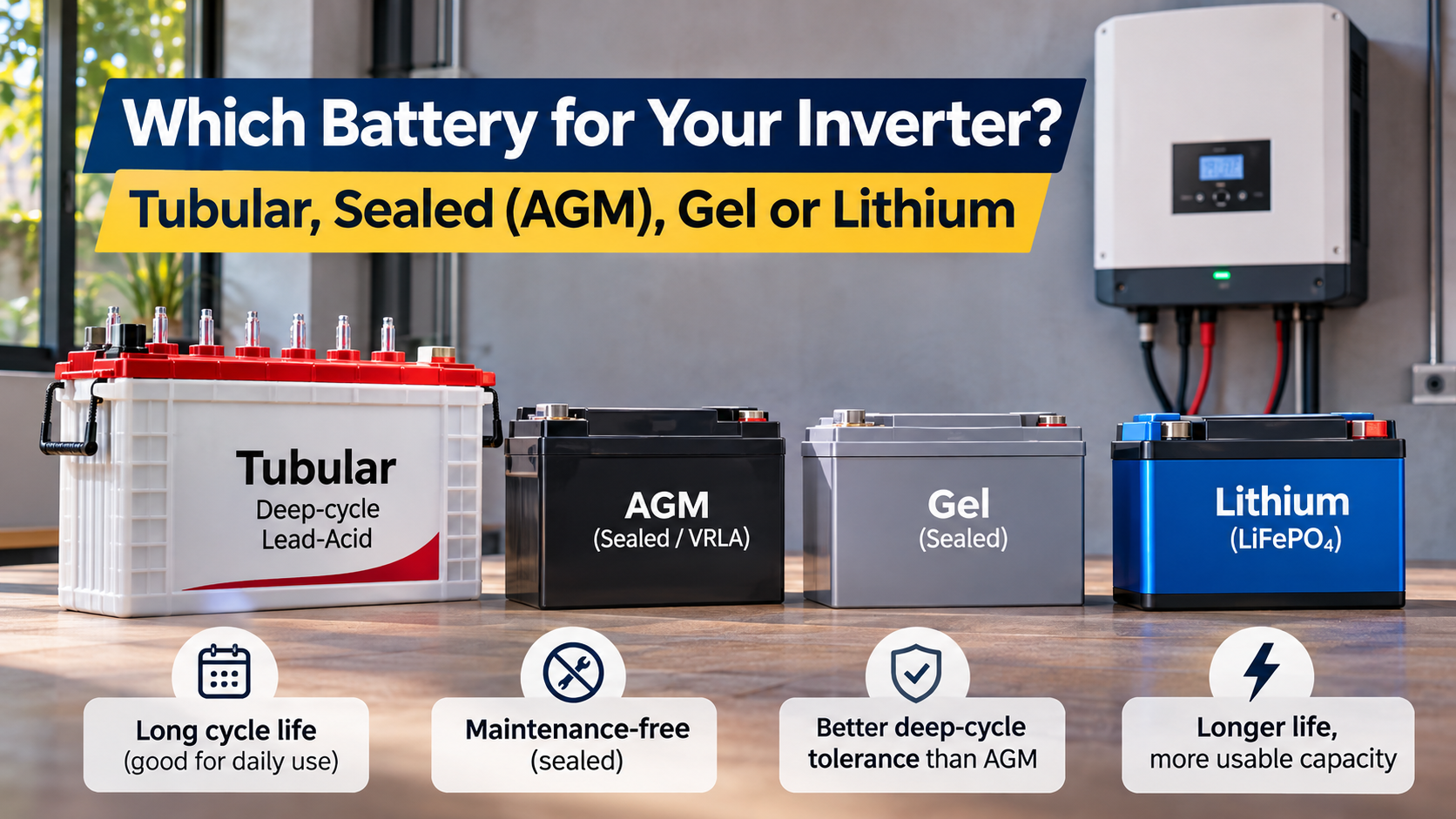
Choosing an inverter is only part of building a reliable backup power system. The battery you pair with it determines how much energy you can store, how long your equipment can run during an outage and how often you may need to replace the battery bank.
Two batteries may both carry a 200Ah rating but deliver very different results over their service lives. Their chemistry, usable depth of discharge, operating temperature, charging requirements and cycle life all matter.
For homes, offices and businesses in Ghana, where power interruptions and high ambient temperatures can affect battery performance, choosing the right type is especially important.
This guide compares four common inverter battery options: flooded tubular, sealed AGM, gel and lithium iron phosphate (LiFePO4). It also explains the main factors to consider when sizing a battery bank.
First, Understand Usable Capacity and Depth of Discharge
An amp-hour (Ah) rating describes a battery's nominal capacity at a stated voltage. It does not mean that all of that capacity should be used during every cycle.
The depth of discharge (DoD) is the percentage of a battery's capacity that has been used. For example, a 50% depth of discharge means half of the battery's nominal capacity has been used.
The recommended depth of discharge depends on the battery chemistry and the manufacturer's specifications. Regularly discharging a lead-acid battery too deeply can shorten its service life. Many lead-acid inverter systems are designed around a conservative usable depth of discharge, often approximately 50%, while compatible lithium batteries may support a deeper usable range.
When comparing batteries, consider:
- Nominal capacity: The battery's rated capacity in amp-hours (Ah), at a stated voltage.
- Usable capacity: The portion of that capacity the manufacturer recommends using.
- Cycle life: The number of charge-and-discharge cycles the battery is rated to deliver under specified conditions.
- Operating conditions: Temperature, charging settings, discharge rate and maintenance all affect performance.
A useful comparison should therefore consider usable energy and expected service life, not just the largest Ah number on the label. Cycle-life figures are meaningful only when the depth of discharge, temperature and test conditions are stated.
The Four Main Inverter Battery Options
1. Flooded Tubular Batteries
Flooded tubular batteries are a traditional option for inverter and solar applications. They use lead-acid chemistry, with positive plates constructed in a tubular design.
The tubular construction is intended to help retain the active material on the plates during repeated charge-and-discharge cycles. A technical white paper from Discover Battery explains the design differences between tubular and flat-plate lead-acid batteries and discusses the potential cycle-life and corrosion benefits of tubular construction. As this is a manufacturer's publication, its performance comparisons should be considered alongside the datasheet for the specific battery being purchased.
Potential advantages:
- Designed for repeated cycling in suitable inverter and solar applications.
- Often available in capacities used for residential and commercial battery banks.
- Can be a practical lead-acid option where routine maintenance is possible.
- Some tubular designs are intended to perform better under demanding cycling conditions than conventional flat-plate designs.
Things to consider:
Flooded batteries require maintenance. Their electrolyte level should be checked according to the manufacturer's instructions and topped up with distilled water when required.
They also need suitable ventilation because charging can release hydrogen gas. Install them in an appropriate, ventilated location and keep them away from flames, sparks and other ignition sources.
A flooded tubular battery may be worth considering where the installation can be maintained properly and the owner wants a deep-cycle lead-acid option.
2. Sealed AGM Batteries (VRLA)
AGM stands for Absorbent Glass Mat. It is a type of sealed lead-acid battery, also commonly described as VRLA (Valve-Regulated Lead-Acid).
AGM batteries do not require routine water topping-up, which makes them convenient for installations where regular battery maintenance is difficult. They are also widely used in uninterruptible power supply (UPS) systems.
However, not every AGM battery is designed for frequent deep cycling. Some are intended mainly for standby applications, where they remain charged and provide power during occasional interruptions.
Before using an AGM battery for an inverter that cycles frequently, check that the specific model is rated for that duty.
Potential advantages:
- Sealed construction with no routine water topping-up.
- Convenient for suitable standby and backup applications.
- Available in a range of sizes and capacities.
Things to consider:
AGM batteries are sensitive to charging conditions and temperature. Excessive heat can significantly shorten their service life.
Riello UPS explains that the rated design life of VRLA batteries is based on an optimum operating temperature, commonly around 20–25°C, and that higher temperatures can reduce service life. The actual effect depends on the battery design and operating conditions.
Read our related guide on how long a UPS battery lasts in Ghana. The same temperature considerations are relevant when assessing sealed lead-acid batteries used in inverter systems.
3. Gel Batteries
Gel batteries are another type of sealed lead-acid battery. Their electrolyte is held in a gel form rather than being freely liquid.
Depending on the model, gel batteries can offer useful deep-cycle performance and the convenience of sealed construction. They do not require routine water topping-up.
Potential advantages:
- Sealed construction.
- No routine electrolyte topping-up.
- Some models are designed for repeated deep-cycle use.
- Suitable options are available for certain solar and inverter applications.
Things to consider:
Gel batteries require a compatible charging profile. Incorrect charging voltage or settings can damage the battery and reduce its service life.
Do not assume that every inverter's generic lead-acid setting is suitable for every gel battery. Confirm the required bulk, absorption and float charging settings in the battery manufacturer's documentation before installation.
A gel battery may be useful where a sealed battery is preferred, provided the inverter's charger is compatible with the battery specifications.
4. Lithium Batteries (LiFePO4)
Lithium iron phosphate, commonly called LiFePO4 or LFP, is increasingly used in solar and inverter battery systems.
Compared with many lead-acid options, LiFePO4 batteries can offer a deeper usable depth of discharge, high cycle life, lower weight and faster charging when used with a compatible system.
They also do not require the water maintenance associated with flooded lead-acid batteries.
Potential advantages:
- High usable capacity, subject to the manufacturer's limits.
- Potentially high cycle life.
- Lower weight than many lead-acid battery banks of comparable usable energy.
- No routine water topping-up.
- Suitable models can support frequent cycling.
Two important considerations:
1. Check the cycle-life conditions.
Cycle-life claims vary between manufacturers and battery models. A figure such as 2,000, 4,000 or 6,000 cycles is not meaningful on its own.
Ask for the product datasheet and check the stated depth of discharge, operating temperature, charge and discharge rates, and end-of-life capacity used for the test.
2. Confirm inverter and charger compatibility.
LiFePO4 batteries require suitable charging settings and a battery management system (BMS). The BMS helps monitor and protect the battery within its operating limits.
A lithium battery should not simply be connected to an inverter designed only for a different lead-acid charging profile. Confirm compatibility with the battery and inverter manufacturers before installation. Some systems may require an inverter with a supported lithium profile or communication connection.
LiFePO4 can be a strong option where the budget, system design and inverter compatibility support it.
How Many Batteries Do You Need for Your Inverter?
A common question is: "How many batteries do I need for a 3,000-watt inverter?"
The inverter's wattage alone does not determine the answer. You need to know the inverter's required battery-bank voltage, the equipment you want to power and how long you want it to run.
Two separate considerations determine the battery bank:
1. Battery-Bank Voltage
The battery-bank voltage must match the inverter's specified DC input voltage. Common configurations include 12V, 24V and 48V.
The inverter determines the required bank voltage. For example, four compatible 12V batteries connected in series can form a 48V bank, provided the batteries and inverter are designed for that configuration.
Always follow the manufacturer's wiring and installation instructions. Incorrect series or parallel connections can create serious electrical hazards.
2. Battery-Bank Capacity
Capacity depends on the electrical load and the required backup time.
Use this basic planning process:
- List the equipment you want to power. Record each device's running power in watts.
- Estimate the backup duration. Multiply the total running watts by the number of hours required. This gives an initial energy estimate in watt-hours (Wh).
- Account for usable depth of discharge. Divide the energy requirement by the permitted usable fraction. For example, if planning around 50% DoD, divide by 0.5.
- Allow for system losses. Inverter efficiency, battery performance, cable losses and starting surges can affect the final design. A qualified installer should account for these factors.
- Convert to amp-hours. Divide the adjusted energy requirement by the battery-bank voltage to estimate the required Ah capacity.
- Choose a suitable battery configuration. Arrange compatible batteries to meet the inverter's required voltage and capacity, following the manufacturer's instructions.
This is a preliminary sizing method, not a final installation design. Motor-driven equipment, pumps and refrigerators may have starting surges that need to be considered separately.
For help identifying the inverter capacity required for your equipment, read what size inverter do I need in Ghana?.
Why Battery-Bank Voltage Matters
For the same power output, a higher DC battery-bank voltage generally means lower current.
For example, a 2,400W load supplied at an idealised 12V would draw about four times the current of the same load supplied at 48V, before accounting for conversion losses.
Lower current can reduce cable losses and make it easier to design systems for larger loads. However, the correct voltage is determined by the inverter and the overall system design.
Do not change a system's battery-bank voltage simply to reduce current. The inverter, batteries, protection devices and cabling must all be designed for the selected voltage.
What Ghana's Conditions Mean for Your Inverter Battery
Battery performance depends on more than chemistry. The installation environment and the way the system is used can have a major effect on service life.
Here are four factors to consider when installing an inverter battery bank in Ghana.
1. High Temperatures
Heat can accelerate battery ageing, particularly in lead-acid batteries.
A battery bank installed in a poorly ventilated cupboard, enclosed roof space or area exposed to direct sunlight may operate above its recommended temperature range.
Choose a shaded, dry and appropriately ventilated location. Follow the manufacturer's clearance, temperature and installation requirements.
2. Frequent Power Interruptions and Deep Cycling
Every time a battery supplies power during an outage, it discharges. Repeated cycling contributes to battery wear.
The effect depends on the battery chemistry, depth of discharge, charging conditions and the number of cycles.
Choose a battery designed for the way the system will actually be used. A battery intended mainly for standby UPS operation may not be the best choice for an inverter that cycles frequently.
3. Inadequate Charging
Batteries need to be recharged using the correct voltage and charging profile.
If a lead-acid battery is repeatedly left undercharged, its performance and service life can suffer. Incorrect charging settings can also damage sealed and lithium batteries.
Voltage fluctuations may affect charging in some installations, but the actual result depends on the inverter or charger's input range and design.
If your system regularly fails to recharge fully, have the incoming supply, charger settings and battery condition checked.
For more information about electricity supply conditions, read what is normal voltage in Ghana?.
4. Dust and Humidity
Dust and moisture can affect battery terminals, connections and the surrounding installation.
Keep the battery area clean and dry. Have terminals and connections inspected as part of routine maintenance, and follow the battery manufacturer's guidance for corrosion prevention.
Do not apply grease or cleaning products to battery terminals unless the manufacturer or a qualified technician recommends them.
Frequently Asked Questions About Inverter Batteries
What is the best battery for an inverter in Ghana?
There is no single best battery for every installation.
Flooded tubular batteries can be suitable where maintenance and ventilation are available. AGM and gel batteries offer sealed options, but their suitability depends on their cycle rating and charging requirements. LiFePO4 can provide high usable capacity and cycle life when the inverter supports it.
The right choice depends on your budget, load, outage frequency, installation environment and maintenance arrangements.
Can I use a car battery for my inverter?
A standard car starter battery is designed mainly to deliver a high current for a short period to start an engine. It is generally not designed for repeated deep discharge.
For regular inverter use, choose a battery specifically rated for deep-cycle or standby service according to the intended application.
Do inverter batteries need water?
Only certain flooded lead-acid batteries require electrolyte-level checks and topping-up.
Use distilled water only when the manufacturer's instructions require it. Sealed AGM, gel and lithium batteries must not be opened or topped up with water.
Can I mix old and new batteries in the same bank?
Mixing old and new batteries in one bank is generally not recommended.
Differences in age, capacity, condition and internal resistance can cause uneven charging and discharging. Follow the battery manufacturer's guidance on matching batteries, and have a qualified installer assess the bank before replacing individual units.
Is lithium worth the investment in Ghana?
LiFePO4 may offer a lower lifetime cost in systems that cycle frequently, but the higher initial purchase price, inverter compatibility and installation requirements must be considered.
Compare the usable energy, cycle-life conditions, warranty, replacement costs and expected usage of the specific models you are considering.
How long should an inverter battery last?
There is no reliable single lifespan for every inverter battery.
Service life depends on battery chemistry, temperature, depth of discharge, charging quality, maintenance and how frequently the battery is cycled. Use the manufacturer's datasheet and warranty conditions as a starting point, and arrange periodic checks.
Get Your Inverter Battery Bank Sized Correctly
Choosing an inverter battery is a technical decision that affects the reliability and long-term cost of your backup power system.
The right battery must match your inverter's DC voltage, your expected electrical load, the backup time you need and the conditions where the battery will be installed.
Energy Links Ghana supplies and installs inverter and solar power solutions for homes, offices and businesses across Ghana. Our product range includes Power Star inverters and hybrid solar inverters, alongside UPS systems and Ortea voltage stabilizers.
Before recommending a battery bank, it is important to understand what you intend to power, how long you need backup and whether the installation can meet the battery's charging, ventilation and maintenance requirements.
Contact Energy Links Ghana with your equipment list and backup requirements so our team can help assess a suitable system.
You can also browse our available products to explore power protection and backup solutions.
Energy Links Ghana – Reliable Power Protection for Homes and Businesses.
Need help choosing the right equipment?
Our engineers will size it against your actual load, not a guess.
Talk to us