
Power Protection
Generator Servicing: The Schedule That Keeps a Standby Set Reliable
· 9 min read · Energy Links Ghana
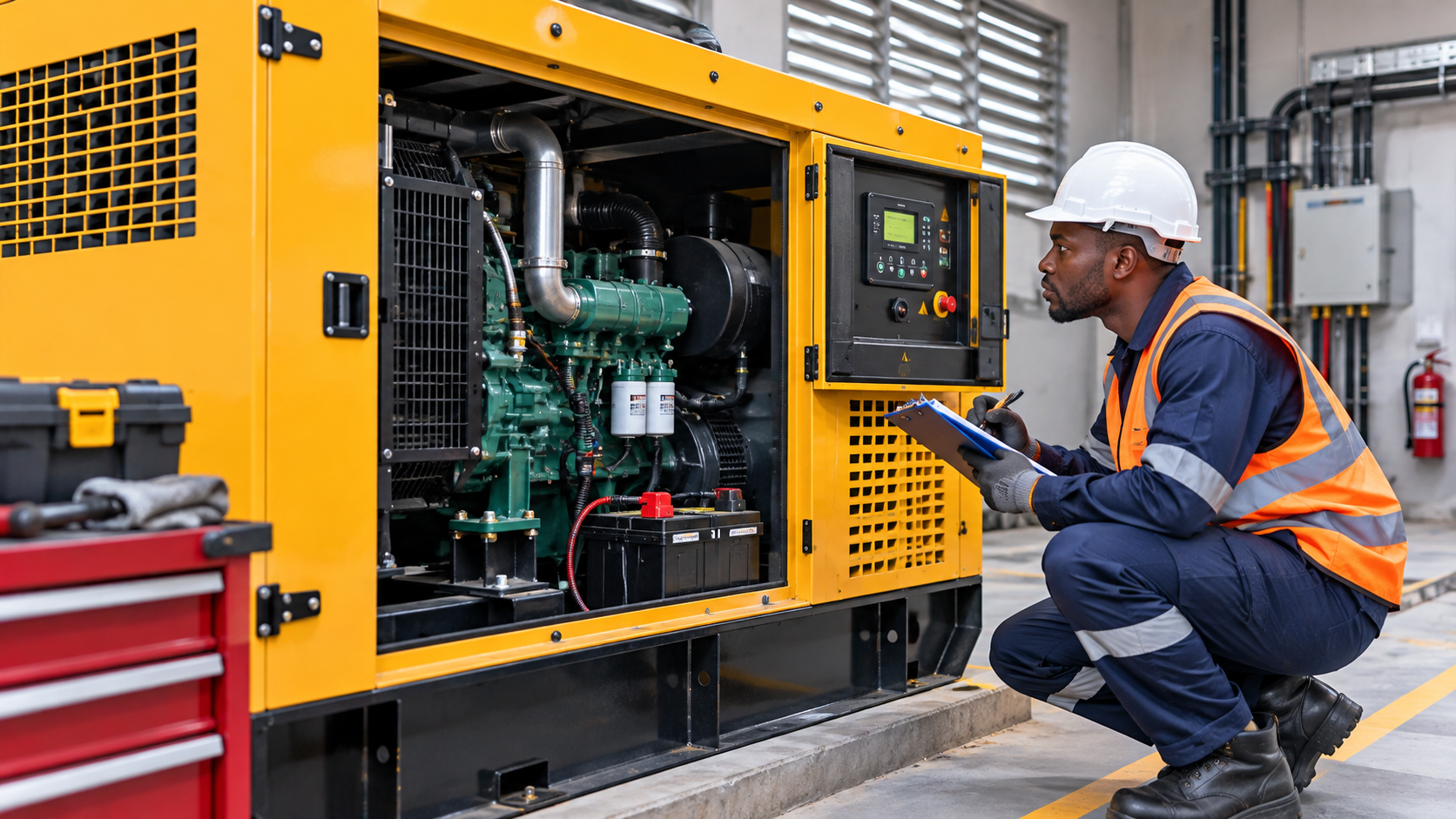
The most dangerous thing you can do to a standby generator is leave it alone. A set that sits untouched for months is not being preserved; it is quietly accumulating the four faults that cause most standby failures — a flat starting battery, degraded fuel, water in the system, and carbon deposits from never running under proper load.
The uncomfortable statistic in this field is that generators overwhelmingly fail when first called upon, not in the middle of a run. By then it is too late to find out.
There is a well-established schedule for avoiding that, and the useful thing is that most of it costs nothing but attention.
The reference schedule, and where it comes from
The most widely used benchmark for testing emergency power systems is NFPA 110. It is a United States standard, so it is not Ghanaian law and it is written for essential electrical systems in facilities like hospitals — but as an engineering baseline it is the clearest published statement of how often a standby set should be exercised and under what load, and the reasoning applies anywhere.
The Office of the State Fire Marshal in Kansas publishes a plain-language summary of those requirements, citing NFPA 110, and it is worth quoting directly because the specifics matter.
Inspection and testing
- Generator sets are to be inspected weekly, monthly and annually.
- Tested twelve times a year under load conditions, at "intervals not less than 20 days or exceeding 40 days", including "a complete simulated cold start" and "transfer of all essential electrical system loads".
The monthly load run
- Exercised at least monthly for 30 minutes, at not less than 30% of the nameplate rating.
This is the item owners skip most often, and the one that matters most. Thirty minutes a month at a real load, not a two-minute idle.
When you cannot reach 30%
The document is specific about diesel sets that cannot be loaded to 30% in normal operation. Those must instead be exercised monthly with whatever load is available, plus an annual load bank test of two hours total, staged as:
- 25% for 30 minutes
- 50% for 30 minutes
- 75% for 60 minutes
And it gives the reason plainly: the requirement applies to diesel sets rather than petrol ones "due to the carbon buildup that occurs in diesel systems". The load bank test "forces/blows out a large portion of the carbon buildup that occurs overtime from not fully utilizing the equipment".
Oil and filters
The same document's maintenance chart specifies oil changes and oil filter replacement at 50 hours or annually — whichever comes first. That second half is the part people miss: oil degrades on the calendar whether the engine runs or not, so a set that has done almost no hours still needs its annual change.
And the performance standard behind it all
The document also states the ten-second rule: the set "shall be maintained to be capable of supplying service within the shortest time practical and within 10-seconds after the interruption of the normal service". That is the standard a well-maintained standby set is held to, and it is a useful way to think about what "reliable" means in practice.
Why light running is a real fault
This is the part that surprises owners, and it explains why the monthly load requirement has a minimum percentage rather than just a duration.
A diesel engine running at a small fraction of its rated load never reaches proper combustion temperature and cylinder pressure. Fuel burns incompletely. Unburnt fuel and lubricating oil work past the piston rings and accumulate in the exhaust system — the condition commonly called wet stacking — and the bores glaze, the injectors foul and the turbo coking begins. The symptoms are smoke, oil consumption and loss of power, on a set with very few hours on the clock.
So an oversized generator is not a conservative purchase. It is a maintenance liability, because it will spend its life lightly loaded. This is one of the reasons right-sizing matters so much, and we cover it in what size generator do I need.
The four things Ghanaian conditions make urgent
The standard schedule assumes a temperate, dry, clean environment. Adjust for ours.
Harmattan dust shortens every air-side interval
Dust loads air filters far faster here, and a restricted filter costs the engine power and raises exhaust temperature. Treat the manual's air filter interval as a maximum rather than a target, inspect the element monthly during Harmattan, and never run a set with its enclosure panels off as a workaround for a dirty filter.
Dust also settles on radiator cores and on alternator windings. A blocked radiator core causes overheating that looks like a coolant fault.
Humidity puts water in the fuel
Water condenses in a part-full tank as it heats and cools daily, and water in diesel supports microbial growth — the black or brown sludge that blocks filters and corrodes tank bottoms. The official maintenance chart above lists checking for water in the fuel system weekly.
Practical measures: keep tanks as full as practical to reduce the air space, drain water from the filter bowl and tank sump on schedule, and have fuel quality checked if a set has been standing for a long period. Fuel does not last indefinitely, and a tankful that has sat for a year through two rainy seasons should be treated with suspicion rather than confidence.
Heat is working against the cooling system continuously
An engine rated at reference conditions is producing less power and rejecting more heat in an Accra afternoon. Coolant level and condition, radiator cleanliness, fan belt tension and free airflow around the enclosure all move from routine to important. Check that hot exhaust air is not recirculating back into the air intake — a common and entirely avoidable installation fault.
The starting battery is the single most common failure
A standby generator is started by a battery, and that battery sits on a charger for months doing nothing, in heat. Heat is the dominant factor in lead-acid battery life — the same physics we describe for UPS batteries in Ghana applies here. A great many "the generator would not start" calls are a starting battery, a corroded terminal, or a charger that quietly stopped working months ago.
Test it, do not look at it. And check the charger is actually charging.
A practical schedule you can actually keep
Adapt the intervals to your manufacturer's manual, which always takes precedence, but this is the shape of it.
Weekly, five minutes
- Check fuel level in the main and day tanks.
- Check oil and coolant levels.
- Check for water in the fuel filter bowl, and drain if present.
- Look for leaks under and around the set — fuel, oil, coolant.
- Confirm the control panel is in automatic and shows no alarms.
- Confirm the battery charger is on and the starting battery is holding voltage.
Monthly, under an hour
- Run the set for at least 30 minutes at 30% of nameplate or more — a real load, not idle.
- Include a cold start, and watch how long it takes to start and accept load.
- Check for abnormal smoke, noise or vibration while it runs.
- Inspect the air filter, more often in Harmattan.
- Test the starting battery properly rather than inspecting it.
- Confirm the transfer arrangement actually transfers. A generator that runs but does not take the load has not been tested. See changeover switch or ATS.
Quarterly to semi-annually
- Drain water from the fuel tank sump.
- Clean the radiator core and check belts and hoses.
- Check and clean battery terminals.
- Inspect the exhaust system and silencer mounts.
Annually
- Oil and oil filter change, at 50 hours or annually, whichever comes first.
- Fuel filters and air filter replaced.
- Coolant tested, and replaced on the manufacturer's interval.
- Load bank test if the set cannot reach 30% in its monthly runs, staged as above.
- Full inspection by a competent engineer, including the alternator, controls and protective devices.
- Fuel quality checked if the set stands for long periods.
Keep a log
A written record of every run, every reading and every service is what turns this from a chore into information. A set whose starting time has crept from eight seconds to eighteen is telling you something, and only a log will show it.
Frequently asked questions
How often should a generator be serviced in Ghana?
Weekly checks, a monthly load run of at least 30 minutes at 30% or more of nameplate, and an annual service including oil and filters at 50 hours or twelve months, whichever comes first. Dust and humidity argue for shorter air and fuel intervals than the manual's default.
Do I still need to service a generator that never runs?
Yes, and arguably more. Oil degrades on the calendar, fuel degrades in the tank, water condenses, and the starting battery dies regardless. A set that never runs is the classic case of a generator that fails on the one day it is needed.
Is idling the generator for ten minutes enough?
No. Idling is close to the worst thing you can do to a diesel set, because it is light-load running — exactly the condition that causes carbon buildup. The requirement is a real load for a real duration.
What is a load bank test and do I need one?
It is a test using portable resistive load equipment to load the set to specified percentages of its rating, staged over about two hours. You need one if your actual load never reaches 30% of nameplate, which is common where a set was oversized.
How long does diesel last in a generator tank?
Not indefinitely, and less in a humid climate where water condenses into the tank. If a set has stood a long time, have the fuel checked rather than assuming it is good.
My generator starts but trips when the pump comes on. Is that a service problem?
Usually a sizing problem rather than a servicing one — the starting surge exceeds what the set can deliver. See what size generator do I need.
Does a generator protect my equipment from bad voltage?
No. Running on generator supply does not address what the mains delivers the rest of the time, and that is where most appliance damage in Ghana comes from. See what is normal voltage in Ghana and surge protector, stabilizer or UPS.
Put it on a scheduled routine
The schedule above is not difficult. The problem is that it is nobody's job, so it does not happen, and the failure surfaces during the one outage that mattered.
Energy Links treats after-sales servicing as part of the work rather than an upsell. We arrange a scheduled servicing routine based on each client's requirements, so that equipment we supply and install keeps working months and years after purchase — for rural banks, Lister Hospital, Advans Ghana, hotels, telecoms firms and a university college. We also carry generators alongside UPS systems, inverters and Ortea stabilizers.
Ask us about a servicing schedule for your set, including one we did not supply, and we will set the intervals against how you actually use it and the conditions it sits in. Or see what we carry if you are still choosing.
Need help choosing the right equipment?
Our engineers will size it against your actual load, not a guess.
Talk to us