
Buying Guides
Pure Sine Wave or Modified Sine Wave? Choosing an Inverter in Ghana
· 9 min read · Energy Links Ghana
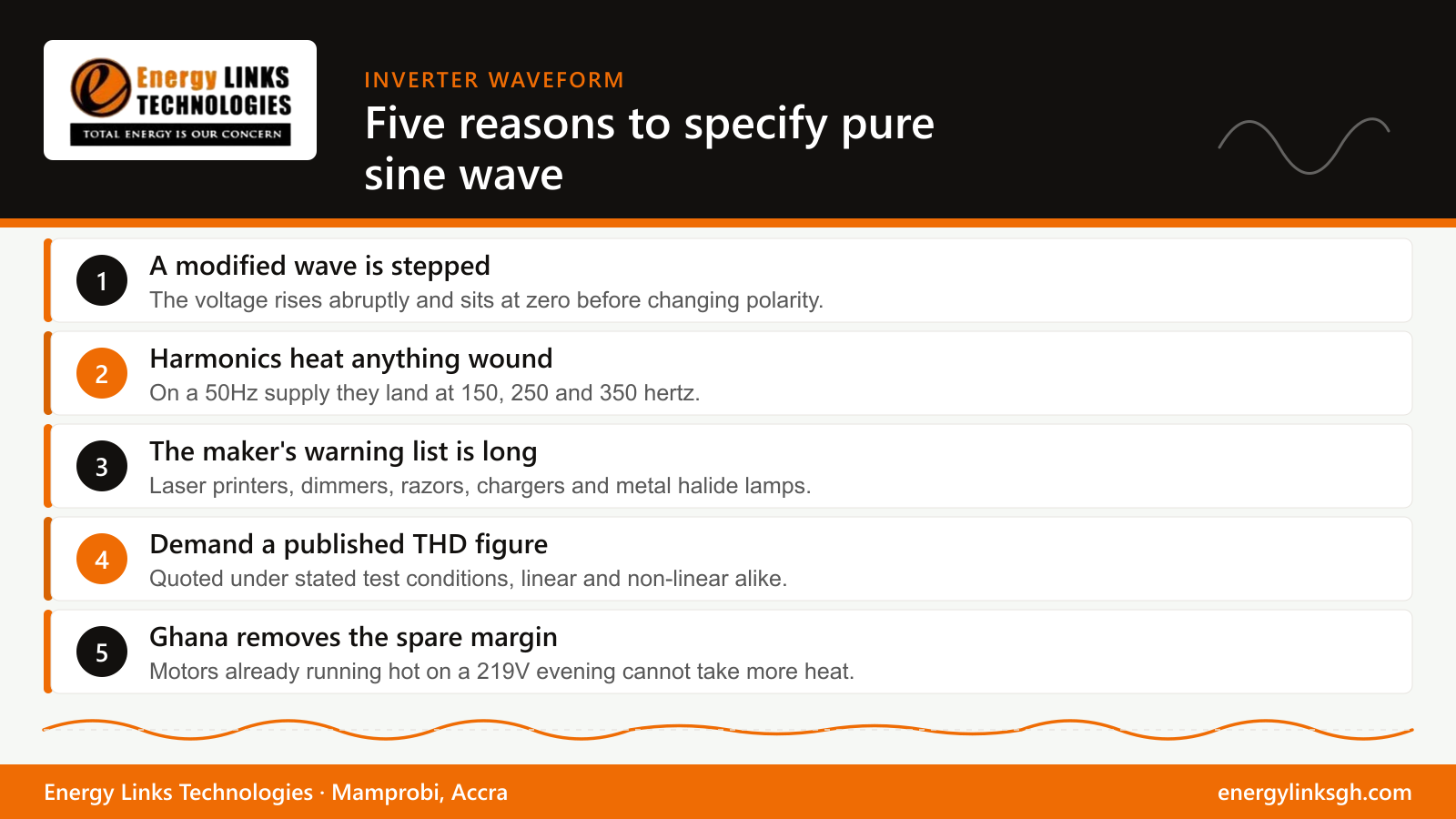
The answer most people need. Buy a pure sine wave inverter. Specify it in writing, and check the specification sheet rather than the box.
A modified sine wave inverter will run resistive loads — incandescent bulbs, a kettle, a soldering iron — perfectly well, and it will usually cost less. Everything else is a gamble that ranges from "works but runs hotter" to "will not work at all" to "may be damaged". The saving is real and small. The risk is spread across every motor, charger and electronic control in your building.
That is the recommendation. The rest of this post explains what the waveform actually is, what the manufacturers are willing to state, what nobody seems willing to measure, and the one Ghanaian regulation worth knowing about.
What the two waveforms actually are
Your mains supply is a sine wave. The voltage rises smoothly to a peak, falls smoothly back through zero, and does the same in the opposite direction, fifty times a second here.
A pure sine wave inverter reproduces that shape. Samlex America, which manufactures inverters, describes its pure sine output as having "a sine wave form like the sine wave form of the mains / utility voltage", with smooth voltage changes and an instant polarity change at 0V.
A modified sine wave inverter does not. It approximates the shape with steps. In Samlex's own description of its modified output, "the voltage rises and falls abruptly", and the output "sits at 0 Volts for some time before changing its polarity".
That stepped shape is not a cosmetic difference. A square-edged, stepped waveform contains energy at frequencies that are multiples of the fundamental — harmonics. Samlex lists the odd harmonics present in a modified sine wave as the third, fifth and seventh. Its figures are given for a 60 hertz supply, at 180, 300 and 420 hertz. Ghana runs at 50 hertz, so on a Ghanaian supply the same harmonics fall at 150, 250 and 350 hertz. The principle is identical; the frequencies are not, and a datasheet written for North America needs that translation.
Those harmonic currents do no useful work. They circulate, and they produce heat in anything with a winding or a core.
What a modified sine wave actually does to your appliances
This is the part where the industry is long on warnings and short on measurements, so it is worth separating what is documented from what is merely repeated.
What the manufacturer states. Samlex attributes a "higher heating effect" in motors and microwaves to the harmonic content of a modified sine wave, and says a pure sine wave lets inductive loads such as motors and microwaves run "cooler". It goes considerably further on specific equipment, listing devices that may malfunction or be damaged on a modified sine wave:
- Laser printers, photocopiers and magneto-optical drives may malfunction
- Clocks in clock radios, coffee makers, microwaves and similar appliances may keep poor time
- Dimmers, and fan or motor speed controls, may stop working, as may speed-controlled sewing machines
- Transformer-less devices such as electric razors, some flashlights, smoke detectors and some hand-tool battery chargers may be damaged
- Some microprocessor-controlled furnace and burner controls may not work
- Metal halide lamps may be damaged
- Some fluorescent fittings with power-factor-correction capacitors may trigger an overload shutdown
That is a manufacturer's own published list about its own product line, which makes it unusually credible evidence. It is also, note, qualitative: "may malfunction", "higher heating effect".
What we could not verify, and will not state as fact. We looked for published measured data — temperature rise, efficiency loss or motor life on a modified sine wave against a pure sine wave under test. We did not find it from a source worth citing. The percentage figures that circulate on this subject come from vendor blogs and reference pages, they disagree with each other, and several of them quietly mix up different quantities — a motor efficiency reduction, a total harmonic distortion figure and a heating factor are three different measurements and are not interchangeable.
So we are not going to hand you a number. The honest position is the one the manufacturers themselves take: harmonic content causes extra heating in inductive loads, the effect is real and directional, and the magnitude depends on the specific appliance. If a supplier quotes you a confident percentage, ask which test it came from.
The number you can actually demand: total harmonic distortion
There is one specification that makes this measurable, and you should insist on seeing it: output voltage total harmonic distortion, usually written as THD. The lower it is, the closer the output is to a true sine wave.
A good unit publishes it. The CyberPower OLS3000ERT2U, an online double-conversion UPS, specifies on its datasheet a pure sine wave output with THD under 3 percent on a linear load and under 5 percent on a non-linear load, with output voltage held within 1 percent of a configurable 230V nominal.
Three things to take from that example.
- There is a figure, and it is published. If the inverter or UPS you are being offered has no THD specification anywhere in its documentation, that absence is itself information.
- THD is quoted under stated test conditions. Under 3 percent on a linear load and under 5 percent on a non-linear load are two different claims. A single number with no test condition attached is close to meaningless.
- Published THD limits vary by model and by rating, and the industry's general benchmarks differ between standards and editions. We are not citing a universal threshold, because the sources we checked do not agree on one. Compare the figures of the actual units you are choosing between.
Why this matters more in Ghana than in the brochure's home market
An inverter's waveform is a decision about the quality of power you generate. Everything else about Ghanaian conditions is about the quality of power you receive — and the two compound.
The Kleinman Center study of voltage quality in Accra measured customers averaging about 219V against the 230V nominal, with voltage more than 20 percent below nominal common in the 6pm to 10pm evening peak, and about 1.6 hours of bad voltage per day. Of the more than 2,000 Accra households and businesses surveyed, 26 percent had appliances damaged by voltage fluctuations in the preceding year, and only 25 percent owned any protective device at all.
Consider what that means for a motor in an Accra building. It already runs on a supply that spends part of the day well below nominal, and already runs hot for that reason. Feeding it a waveform that adds harmonic heating on top is stacking one stress on another. The appliances most at risk from a modified sine wave — fridge and freezer compressors, pumps, fans, air conditioners — are exactly the appliances already working hardest here.
This is the practical case for pure sine wave in Ghana specifically. It is not that the waveform is dangerous in isolation. It is that it removes a margin you cannot spare.
For the supply-side half of the problem, see what is normal voltage in Ghana and the three-way comparison in surge protector, stabilizer or UPS.
One Ghanaian regulation worth knowing about
Inverters sold in Ghana are not outside the regulatory frame. The Energy Commission's own regulation listing includes the Renewable Energy (Standards and Labelling (Inverters)) Regulations, 2022, cited as LI 2461, alongside corresponding instruments for solar panels and renewable energy batteries.
We are telling you it exists and giving you its title and year, which we confirmed on the Commission's own site. We have not read its text and we are not going to tell you what it requires — the document was not readable in a form we could quote, and inventing its contents would be worse than silence.
What you can reasonably do with that: ask a supplier whether the inverter they are selling you complies with the Energy Commission's inverter standards and labelling regulations, and ask to see the labelling. A supplier who has never heard of it is telling you something about how they source.
Where a modified sine wave is genuinely fine
In fairness, there are cases.
- Purely resistive loads. Incandescent bulbs, a kettle, a heating element, a soldering iron. No windings, no electronics, nothing to object.
- A dedicated single-purpose installation where you control exactly what gets plugged in, and nothing on the list above is on it.
- A temporary or emergency arrangement where the alternative is no power at all.
What makes this unsafe as a general purchase is not the waveform. It is that you cannot control what gets plugged in afterwards. An inverter installed for lights becomes the inverter that runs a laptop charger, then a fan, then a small fridge, because that is what people do during an outage. A modified sine wave inverter in a building is a constraint that nobody remembers in three years' time.
Frequently asked questions
Will a modified sine wave inverter run a fridge?
It may start and run one, but the compressor is an inductive motor load and the manufacturers' own position is that such loads run hotter on a modified wave. For a fridge or freezer you intend to rely on, use a pure sine wave inverter.
Will it run an air conditioner?
Treat pure sine wave as a requirement rather than an upgrade for air conditioning, and read can an inverter run an air conditioner first — the starting surge is a larger obstacle than the waveform.
Is "true sine wave" the same as "pure sine wave"?
Yes. The two terms are used interchangeably in the market. What distinguishes products is the published THD figure, not the adjective on the box.
Does my UPS have a pure sine wave output?
An online double-conversion unit rebuilds the waveform and publishes a THD figure. Cheaper standby units often pass the mains through in normal mode and produce a stepped wave on battery. The topologies are compared in online or line-interactive.
Should I replace a modified sine wave inverter I already own?
Not necessarily. Work out what is actually plugged into it. If it is lights and resistive loads and nothing on the manufacturer's warning list, it is doing its job. If it is running motors or electronics you depend on, plan a change.
Does the waveform affect how long my battery lasts?
Not directly, but a load that runs hotter and less efficiently draws more for the same work. Sizing and runtime are covered in what size inverter do I need and how long a 200Ah battery lasts.
Specify it properly, once
Waveform is one of the few inverter decisions that is effectively permanent, because it governs everything anyone will ever plug in. It is also one of the easiest to get wrong, because the cheaper option works well enough on the first day to look like a good purchase.
Our engineers will go through what you actually intend to run, insist on a published THD figure for the unit being quoted, and tell you plainly where a modified sine wave would be adequate and where it would not.
Contact us to discuss your installation, or browse the inverters and power equipment we stock.
Need help choosing the right equipment?
Our engineers will size it against your actual load, not a guess.
Talk to us