
Inverters & Solar
How to Test an Inverter Battery With a Multimeter, and What the Reading Cannot Tell You
· 9 min read · Energy Links Ghana
A multimeter can tell you how charged your inverter battery is. It cannot tell you whether the battery is any good. Those are two different questions, and conflating them is why so many banks get replaced that did not need replacing, and so many get kept that did.
The useful news is that the measurement that is available to you costs nothing, takes two minutes, and is more informative than most owners realise — provided you do it in the right conditions. Almost nobody does. Below is the procedure, the manufacturer's own numbers, the four errors that corrupt a reading, and an honest statement of where voltage stops being able to help.
What you are actually measuring
The reading that means something is called open-circuit voltage, or resting voltage. It is the voltage across a battery's terminals when nothing is charging it and nothing is drawing from it, and it has settled.
For a flooded or sealed lead-acid battery, open-circuit voltage tracks the state of charge reasonably closely, because it reflects the chemical state of the electrolyte. That relationship is what makes a multimeter useful at all. Trojan Battery, a US manufacturer of deep-cycle lead-acid batteries, puts it this way in its FAQ: "Battery voltage also indicates the level of charge when measured in an open circuit condition."
The last five words are the whole difficulty. The moment the inverter is running, or the charger is on, or the bank has just come off charge, you are no longer measuring open-circuit voltage. You are measuring something else, and the number you read means something else too.
The procedure
Set your multimeter to DC volts, on a range that covers at least 20V for a 12V battery. Then:
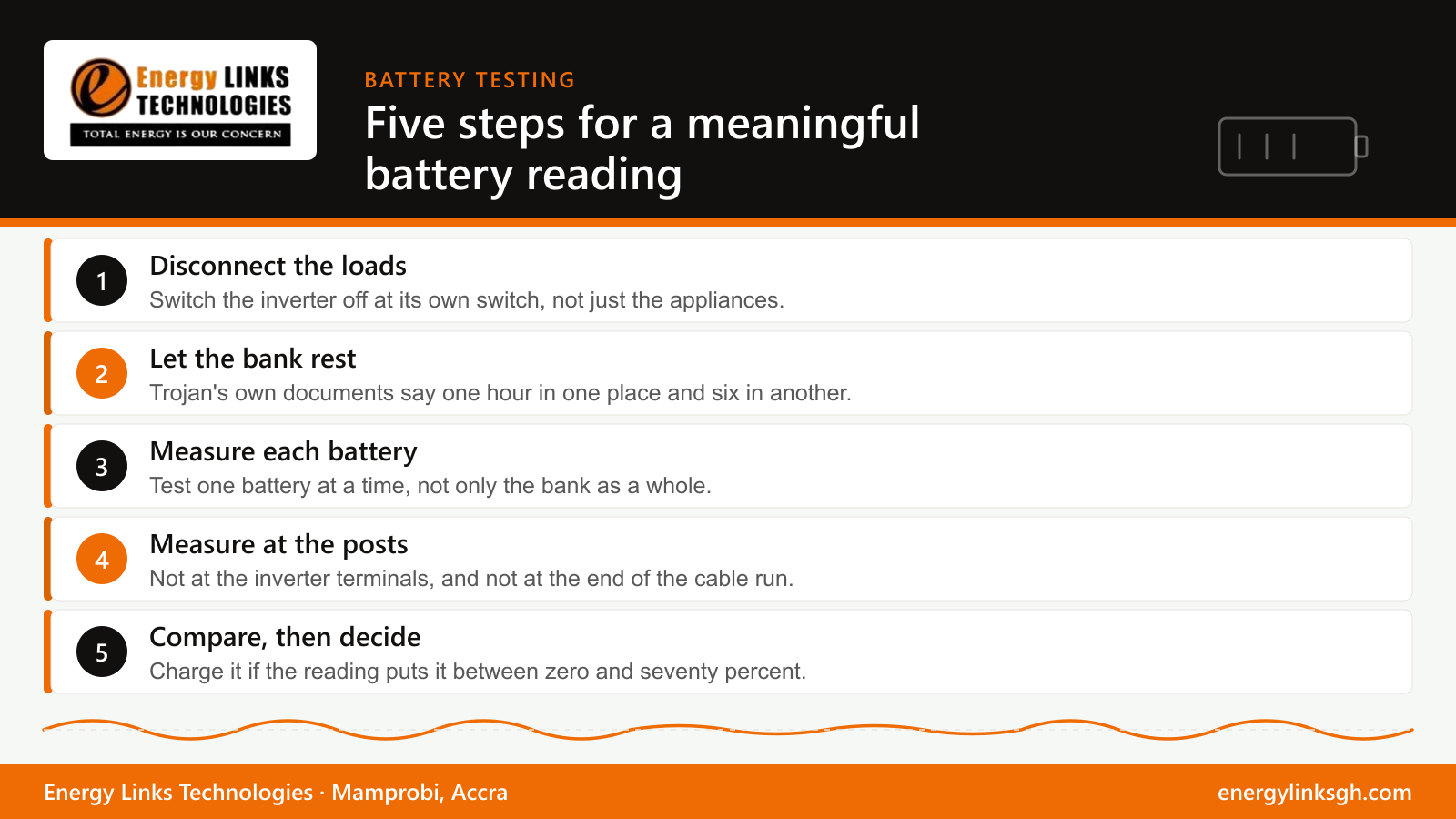
- Disconnect the loads. Trojan's battery maintenance guidance begins the open-circuit voltage test with "Disconnect all loads from the batteries." Switch the inverter off at its own switch, not just the appliances.
- Stop the charging and let it rest. The same guidance states that "batteries must remain idle (no charging, no discharging) for at least 6 hrs, preferably 24 hrs." Trojan's own FAQ gives a shorter figure for the same purpose: "For an accurate voltage reading, the battery should to rest for at least one hour, to let the voltage stabilize." The manufacturer's own two documents disagree, between one hour and six, and we are reporting the spread rather than picking the convenient end. An hour will catch a badly discharged bank. Six hours is what you want before concluding anything about a borderline one.
- Measure each battery, not just the bank. Red probe on positive, black on negative, one battery at a time.
- Measure at the posts. Not at the inverter terminals, and not at the end of the cable run.
- Compare, then decide. Trojan's instruction after reading is blunt: "Charge the battery if it registers 0% to 70% charged."
The manufacturer's numbers, and what they apply to
Trojan publishes state-of-charge figures against open-circuit voltage for its flooded batteries. For a 12V battery, its table gives 12.73 at 100 percent of charge, 12.62 at 90 percent, 12.50 at 80 percent, 12.37 at 70 percent, 12.27 at 60 percent, 12.10 at 50 percent, 11.89 at 40 percent, 11.81 at 30 percent, 11.66 at 20 percent and 11.51 at 10 percent. For a 6V battery the equivalents run 6.37 at 100 percent, 6.25 at 80 percent, 6.02 at 50 percent and 5.75 at 10 percent.
Three qualifications matter more than the numbers.
Look at how small the span is. Between a full battery and a half-empty one there are six-tenths of a volt. Between 40 percent and 30 percent there are eight hundredths. A cheap meter reading to one decimal place cannot resolve that; you want two decimals, and you want to trust them.
These are one manufacturer's figures for one chemistry. They are published by a US company for its own flooded lead-acid products. Gel, AGM and tubular batteries have their own curves, usually close but not identical, and your own battery's data sheet beats this table every time. Which battery for your inverter explains the differences between the types.
On a lithium bank this method barely works at all. A lithium iron phosphate cell holds a nearly flat voltage across most of its usable range, so the few millivolts separating 70 percent from 30 percent are inside the noise. If your bank is lithium, the battery management system's own state-of-charge reading is the instrument, not your multimeter.
The four mistakes that ruin a reading
Measuring with the inverter running. Under load, terminal voltage drops by an amount that depends on the current and the battery's internal resistance. A sound battery supplying a heavy load will read low; a weak battery supplying nothing will read fine. Neither number is a state of charge.
Measuring too soon after charging. A battery straight off charge carries what is often called a surface charge, and it reads high — sometimes high enough to make a tired bank look full. This is the single most common reason an owner reports "the batteries read 12.8 but the backup is five minutes."
Measuring the bank instead of the batteries. Four 12V batteries in series on a 48V bank will show a perfectly plausible total while one of them is dragging. The string hides the weak member, and the weak member is what limits your runtime and what the charger is quietly abusing. Measure each battery individually, then compare them to each other. A battery sitting more than about a tenth of a volt away from its neighbours after a proper rest is the one to investigate. That difference, not the absolute number, is usually the most useful thing a multimeter will tell you.
Measuring at the wrong point. A reading taken at the inverter's DC input includes the voltage drop in the cable. On a 12V system that drop is a meaningful fraction of the whole measurement. What size cable for an inverter explains why the DC run matters so much at low bank voltages.
Temperature, stated accurately
This is where most pages on this subject invent something, so here is exactly what the source says and does not say.
Trojan's maintenance guidance gives a temperature correction for specific gravity, not for voltage. Hydrometer readings are to be corrected to 80º F (26.6º C), adding 0.004 for every 10º F (5.6º C) above that reference and subtracting 0.004 for every 10º F below it.
For open-circuit voltage it publishes no temperature correction at all. Its only voltage-temperature instruction concerns charging, not measurement: "Subtract 0.0028 volt per cell for every 1°F (0.005 volt per cell for every 1°C) above 77°F (25°C)."
Temperature still matters enormously to the battery, just not as a correction you apply to this reading. Riello UPS, an Italian manufacturer, states in its guidance on how temperature affects batteries that the optimum operating range is 20-25C, that battery life halves for every 10 degrees Celsius above that range, and that the safe operating range runs 0-40C. A battery cupboard in Accra in March sits in the upper part of that window or above it, which shortens the life of the bank you are measuring. Inverter battery maintenance covers what to do about the heat.
The three things voltage cannot answer
Trojan's FAQ is refreshingly direct about the limit: "Battery voltage alone does not confirm a problem." Its own next step is a different instrument — "you can confirm the problem by taking electrolyte specific gravity readings using a hydrometer."
Capacity. A battery that has lost half its amp-hours still reaches 12.73 when fully charged. Voltage says the tank is full; it says nothing about how big the tank is. Only a discharge test under a known load answers that, and a proper one is destructive of time rather than of the battery.
Which cell is failing. Voltage is measured across six cells in a 12V battery. A hydrometer reads them one at a time, which is why Trojan's instruction for specific gravity is to "Check all cells in the battery" and "Compare the readings." A single bad cell is visible to a hydrometer and nearly invisible to a voltmeter.
Internal resistance. This is what actually collapses when a battery ages, and it only shows itself when current flows. A resting reading, by definition, cannot see it.
If your bank reads correctly and still gives you a few minutes of backup, the answer is capacity, and no amount of voltage measurement will produce it. How long will a 200Ah battery last works through the runtime arithmetic, and how long does a UPS battery last lists the ageing symptoms.
Frequently asked questions
What should my inverter battery read when fully charged?
For a 12V flooded lead-acid battery, Trojan's figure for 100 percent of charge is 12.73, measured after a proper rest with everything disconnected. Anything appreciably above that means you are still seeing charger voltage or surface charge, not a resting reading.
What voltage means my inverter battery is bad?
None, on its own. A low resting voltage means discharged, which may be the charger's fault, the load's fault, or the battery's. Trojan's position is that voltage alone does not confirm a problem. Combine it with a hydrometer reading per cell, or with a capacity test.
How deeply should I discharge an inverter battery?
Trojan's general recommendation for its deep-cycle batteries is "a discharge of 20 to 50% of the batteries rated capacity." Routinely going deeper shortens the bank's life whatever the voltage reads afterwards.
Can I test an inverter battery without a multimeter?
Partially. On a flooded battery a hydrometer is arguably the better instrument, because it reads cells rather than batteries, and Trojan gives 1.277 or greater as indicating full charge for most of its batteries. On sealed, gel or lithium batteries there is no electrolyte to test, and a meter is all you have.
Why does my battery read fine but the backup is short?
Almost always lost capacity, sometimes a charger that never finishes a charge. Why is my UPS not charging covers the charging faults, and how to calculate UPS backup time covers the arithmetic.
Should I measure the bank or each battery?
Each battery, then compare. The comparison between batteries in the same string is more diagnostic than the total, because a string total averages away the fault you are looking for.
When the meter has told you all it can
A multimeter is the right first instrument and the wrong last one. It will tell you that a bank is flat, that one battery is out of step with its neighbours, or that your charger is not finishing. It will not tell you how many amp-hours you have left to sell your business as backup.
That takes a load test and a look at the charger settings, which is what our engineers do on site, from our base in Mamprobi, Accra. Get in touch or see what we stock. We test before recommending replacement, because a bank that is undercharged is not the same as a bank that is finished.
Need help choosing the right equipment?
Our engineers will size it against your actual load, not a guess.
Talk to us