
Buying Guides
UPS or Inverter? The Difference, and Which One You Actually Need
· 12 min read · Energy Links Ghana
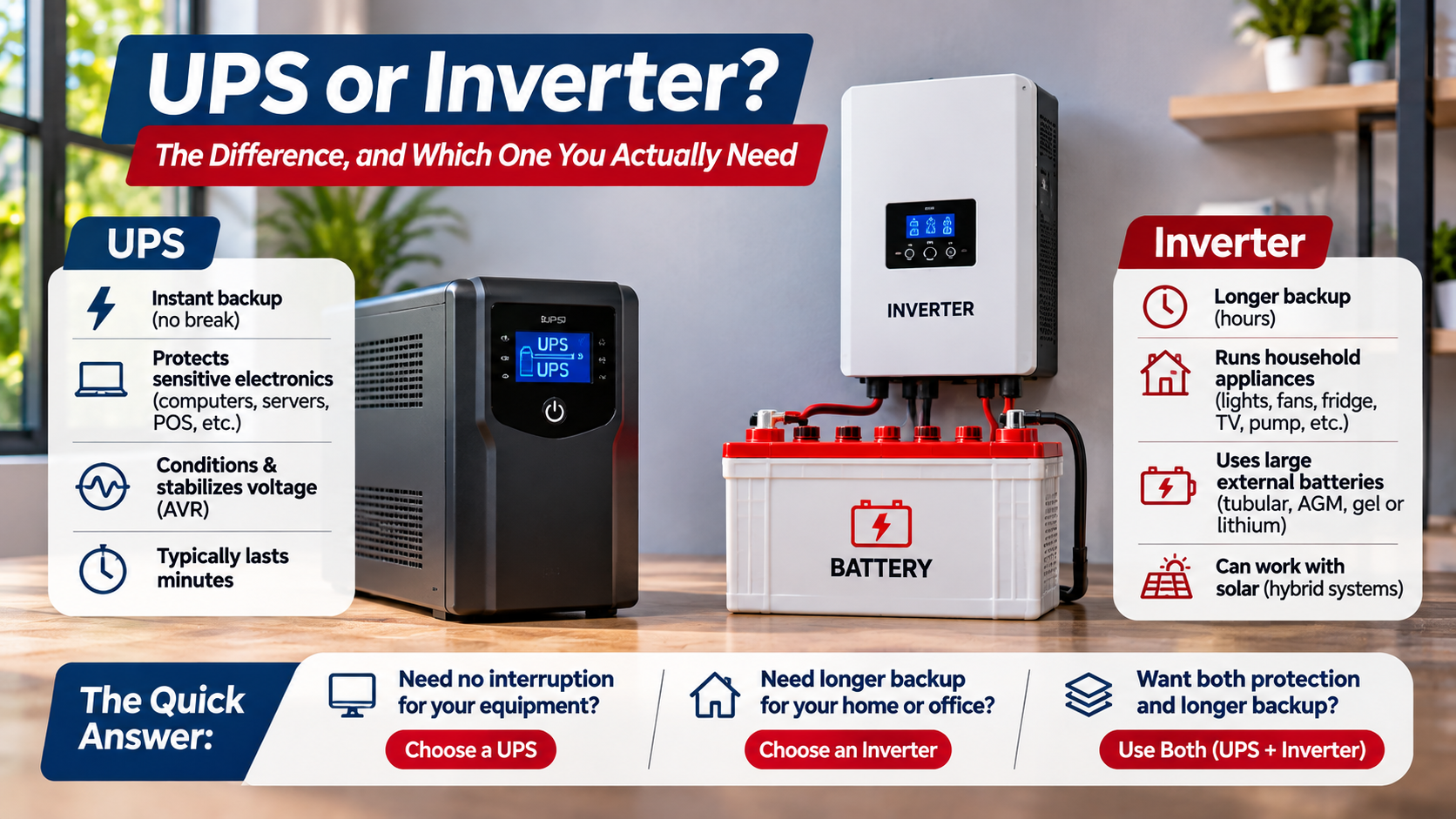
A UPS and an inverter both provide backup power, but they are designed to solve different problems. A UPS is built to protect equipment from interruptions with a very short transfer time, while an inverter system is generally designed to keep selected appliances running for a longer period.
If your priority is preventing a computer, server or point-of-sale terminal from restarting when electricity goes off, a UPS may be what you need. If you want to keep lights, fans, a television or other household equipment running during an extended outage, an inverter with a suitably sized battery bank is usually more appropriate.
Some homes and businesses need both. Understanding how each system works will help you choose the right equipment instead of spending money on a solution that does not meet your requirements.
What Does a UPS Do?
UPS stands for Uninterruptible Power Supply. It provides backup power to connected equipment when the mains electricity supply fails or moves outside the unit's acceptable operating range.
One of the most important features of a UPS is its transfer time: the time taken for the unit to switch from mains power to battery power.
Different UPS technologies have different transfer characteristics:
- Standby or offline UPS: Normally supplies mains power to the connected equipment and switches to battery when a problem is detected. There is a short transfer time.
- Line-interactive UPS: Uses voltage regulation, commonly through Automatic Voltage Regulation (AVR), to help manage certain low- or high-voltage conditions without switching to battery every time.
- Online double-conversion UPS: Continuously converts incoming AC power to DC and then back to AC for the load. This design provides a seamless transition when the mains input fails, within the unit's specified operating limits.
The transfer time matters because electronic equipment has limits on how long it can tolerate an interruption. If the interruption is longer than the equipment's power supply can bridge, it may restart or shut down.
A suitable UPS is therefore useful for equipment such as:
- Desktop computers and workstations.
- Servers and network equipment.
- Point-of-sale systems and payment terminals.
- Security and monitoring equipment.
- Other sensitive electronics that need a controlled shutdown or continuous power.
A UPS is commonly sized to support a critical load for a limited period. Depending on the model, battery condition and connected load, that may provide enough time to save work, shut down safely or bridge a short interruption.
For more detail, read our guide to online and line-interactive UPS systems.
What Does an Inverter Do?
An inverter converts direct current (DC), usually supplied by a battery bank or solar system, into alternating current (AC) that can power compatible appliances.
An inverter backup system is generally designed around runtime: how long the battery bank can supply the connected load.
Unlike many small UPS units, inverter systems commonly use external batteries. The battery bank's usable energy, the connected equipment and the inverter's efficiency all affect how long the system can run.
Depending on its capacity and design, an inverter system can support equipment such as:
- Lights.
- Fans.
- Televisions.
- Routers and other networking devices.
- Refrigerators, where the inverter is correctly sized for their running and starting requirements.
- Selected office equipment and other compatible appliances.
The inverter's power rating determines how much load it can support at a given time, while the battery bank largely determines how long that load can be supported.
An inverter is therefore often a practical option for providing longer backup to selected household or business circuits.
However, not every inverter has the same transfer characteristics. Some models include a fast transfer or UPS mode, while others take longer to switch to battery. Check the manufacturer's specifications if you intend to use an inverter with equipment that cannot tolerate an interruption.
UPS vs Inverter: What Is the Difference?
Although both systems can use batteries and electronic power conversion, their typical design priorities are different.
| Feature | UPS | Inverter system |
|---|---|---|
| Main purpose | Protect critical equipment from power interruptions | Provide longer backup power |
| Transfer time | Designed for a short transfer time; online models provide seamless transfer | Varies by model and operating mode |
| Typical runtime | Often minutes, depending on load and battery | Can provide hours, depending on battery capacity and load |
| Battery arrangement | Often internal batteries in smaller units; larger models may use external banks | Commonly uses an external battery bank |
| Common applications | Computers, servers, POS terminals and network equipment | Lights, fans, televisions and selected household or office circuits |
| Voltage regulation | Some models, especially line-interactive units, include AVR | Depends on inverter design and model |
| Sizing priority | Critical load and required ride-through or shutdown time | Total load and required backup duration |
The right choice depends on what you need to keep running and how sensitive that equipment is to interruptions.
Where the Two Overlap — and Where People Make Mistakes
UPS and inverter systems can overlap in some applications, but they should not automatically be treated as interchangeable.
Here are common mistakes to avoid.
1. Assuming an Inverter Will Always Protect a Computer From Restarting
An inverter may keep a computer powered during an outage, but the time it takes to switch from mains to battery depends on the model and its settings.
If the transfer interruption is longer than the computer's power supply can tolerate, the computer may restart.
If uninterrupted operation is important, use a UPS that is suitable for the computer and the connected load. Check the inverter's transfer-time specification before relying on its backup mode.
2. Expecting a Small UPS to Power an Entire Home
Most desktop UPS units are designed for selected electronics and relatively short backup periods.
Powering an entire home for several hours requires a much larger and more expensive system. An appropriately sized inverter and battery bank are generally more suitable for household backup.
3. Assuming a UPS Replaces a Whole-Building Voltage Stabilizer
A line-interactive UPS may regulate voltage for the equipment connected to its own output sockets.
That does not mean it protects every circuit in the building. Appliances such as refrigerators, air conditioners and water pumps may be connected elsewhere and will not receive that UPS's voltage regulation.
If the whole installation needs voltage protection, have the electrical system assessed to determine whether a suitably rated stabilizer or other protection equipment is appropriate.
4. Assuming Every Hybrid Solar Inverter Works Like a UPS
A hybrid solar inverter can combine battery storage, solar charging and interaction with the mains supply. However, its transfer time and backup behaviour vary by model.
Some hybrid inverters offer a fast backup or UPS mode; others may not be suitable for sensitive equipment that cannot tolerate a brief interruption.
Check the manufacturer's specifications and have the system designed for the equipment it will support.
For a closer look at solar system configurations, read our guide to hybrid, off-grid and grid-tied solar systems in Ghana.
Why This Difference Matters in Ghana
Power protection in Ghana is not only about what happens when electricity goes off. The quality of the supply while electricity is available also matters.
Voltage can vary, and the effect on equipment depends on the size and duration of the variation, the appliance and the protection built into the installation.
A study by the Kleinman Center for Energy Policy examined voltage quality at customer connections in Accra. It reported an average customer voltage of approximately 219V between March 2019 and November 2020, compared with Ghana's nominal voltage of 230V. The study also reported periods of significant under-voltage, particularly during evening peak demand.
Read the research: Improving Voltage Quality Through Transformer Construction in Accra, Ghana – Kleinman Center for Energy Policy.
These findings are useful context, but they do not mean every area or building experiences the same voltage conditions. The supply at an individual property should be measured before choosing equipment based on a suspected voltage problem.
There are three separate power-protection questions to consider:
1. Do You Need Protection From a Sudden Interruption?
If a brief interruption could cause a computer, server, payment terminal or other critical device to restart, a suitable UPS can provide backup during the transfer and give you time to shut down safely.
A line-interactive UPS may also regulate certain voltage variations within its specified input range.
2. Do You Need Backup for a Longer Outage?
If you need lights, fans, networking equipment or selected appliances to continue operating for an extended period, consider an inverter system with a battery bank sized for the expected load and runtime.
The battery must also be able to recharge properly under the available supply conditions. Confirm the inverter's input and charging specifications before purchasing.
3. Do You Need Protection From Voltage Variations?
A UPS with AVR protects only the equipment connected to that UPS, and only within its specified operating range.
If voltage variation affects several circuits or larger appliances, a qualified electrician can assess whether a stabilizer or other suitable protection device is needed for those circuits.
For more context, read what is normal voltage in Ghana?.
How to Decide: UPS, Inverter or Both
Rather than starting with a product, start by identifying what you need to protect.
- List the equipment that cannot tolerate an interruption. This may include desktop computers, servers, network equipment, payment terminals or other sensitive devices.
- List the equipment you want to run during a longer outage. This may include lights, fans, a television, a router and selected appliances.
- If the first list matters, consider a UPS. Size it for the critical equipment and the backup time required. Our UPS sizing guide explains the key considerations.
- If the second list matters, consider an inverter. Size the inverter for the connected load and the battery bank for the required runtime. Our guide to what size inverter you need in Ghana can help you understand the process.
- If both lists matter, you may need both systems. A common arrangement is for an inverter to supply selected building circuits, with a UPS connected downstream to protect critical electronics from the inverter's transfer interruption. The design must account for compatibility, earthing, neutral arrangements, protection devices and the manufacturer's instructions.
- Assess voltage protection separately. If voltage variations affect other circuits, ask a qualified electrician to assess the installation and recommend suitable protection. See why you need a voltage stabilizer in Ghana and surge protector, stabilizer or UPS.
What About a Generator?
A generator can provide electricity for longer outages, but it usually takes time to start and stabilise before it can supply the load.
That delay means a generator alone may not prevent a computer or server from losing power during the transition.
In installations where even a short interruption is unacceptable, a UPS can support critical equipment while a generator starts and takes over, provided the generator and UPS are correctly specified and compatible.
For a home, the choice between an inverter and a generator also involves fuel costs, noise, maintenance, installation and the expected length of outages.
Read our comparison of inverter vs generator for a Ghanaian home.
Frequently Asked Questions
Is a UPS the same as an inverter?
No. Both can provide backup power, but a UPS is designed to protect connected equipment from interruptions with a short transfer time, while an inverter system is commonly selected to provide longer backup using a battery bank.
Some inverters include a fast UPS mode, so check the specifications of the particular model.
Which is better for a home in Ghana?
If your main goal is to keep household lights, fans and selected appliances running during an outage, an appropriately sized inverter system is usually the more suitable choice.
A UPS is useful for specific home equipment, such as a desktop computer or network device, that should not restart during a brief interruption.
Some homes benefit from using both.
Can I use an inverter instead of a UPS for my computer?
Possibly, but it depends on the inverter's transfer time and the computer's ability to tolerate the interruption.
If the computer must remain on without restarting, use a suitable UPS or an inverter system whose specified transfer performance is compatible with the equipment.
Can a UPS replace a voltage stabilizer?
Not in every situation. Some line-interactive UPS models include AVR, but this regulates the power supplied to equipment connected to that UPS.
It does not automatically protect the rest of the building. A separate stabilizer may be appropriate for other circuits after the installation has been assessed.
Do I need both a UPS and an inverter?
You may need both if you want longer backup for household or office circuits and uninterrupted power for sensitive electronics.
The inverter can provide longer-duration backup, while the UPS protects critical equipment from a brief interruption during a transfer. Both systems must be correctly sized and installed.
How long can a UPS or inverter run?
Runtime depends on the connected load, battery capacity and condition, inverter or UPS efficiency, and operating conditions.
A UPS is often intended to provide a short period of backup, while an inverter battery bank can be sized for a longer duration. Ask for a runtime estimate based on your actual equipment rather than relying on the product's maximum rating alone.
Get the Right Backup Power Solution for Your Needs
Choosing between a UPS and an inverter starts with understanding what you need to protect and how long you need it to run.
A UPS is designed to protect critical electronics from brief interruptions. An inverter system is generally designed to provide longer backup for selected household or business loads. In some installations, using both is the most practical solution.
Energy Links Ghana supplies and installs power protection and backup solutions for homes, offices and businesses across Ghana.
Our range includes EAST, Inform and Siel UPS systems, Power Star and hybrid solar inverters, and Ortea voltage stabilizers.
Whether you need backup for office computers, a server room, a payment terminal or essential household appliances, the system should be selected according to your actual load, required runtime and site conditions.
Contact Energy Links Ghana to discuss your backup power requirements, or browse our available products to explore suitable solutions.
Energy Links Ghana – Reliable Power Protection for Homes and Businesses.
Need help choosing the right equipment?
Our engineers will size it against your actual load, not a guess.
Talk to us